Showing posts with label art. Show all posts

Monday, March 5, 2012

Tell me, who is Helena?


The paper has arrived! Clara and I have been fortunate enough to receive of gift of good, sturdy fine art paper from which to build our pop-up book. Clara's father, who is an art professor, insisted that a project this artful should, indeed, be a work of art and therefore must be crafted out of quality materials--so he sent us a generous gift of beautiful, strong bristol board among other papers.

Serendipitously enough, the box the paper came in is the perfect size for crafting an overlarge pop-up book and Clara and I are already plotting ways to paint it white and make it the cover of our book. As Clara begins to construct prototypes of the four sets that will form the pop-up book (you will see the pictures scattered throughout this entry), I have begun to think about the ways in which the book and pop-ups and writing will feature in the production of the play itself.

In a meeting at the beginning of the semester, my thesis supervisor, Ralph Cohen, challenged me to make sure that the concept Clara and I had created for the design of the production was a part of the directing of the production as well. This was something I had already been considering--in the early stages of this process, Clara and I tossed around
various ideas: having characters quite literally be on book, reading their lines, characters performing the act of writing in significant moments in the play, and even--in a wild moment--burning the entire paper set as a statement about the ephemerality of theater (something we have reconsidered in the face of our tremendous hours of work and the quality of some of our materials).

As we have settled into our ideas somewhat, it has become the connection between gender identities and paper and writing that most interests me and will be at the center of what I do as the director of this production. We have been thinking of pop-ups as feminine--paper telling its own story--and written text as masculine--the phallic pen put to passive paper. And what originally drew me to this play was the way in which Helena both does
and does not write her own story. She has more soliloquies than most of Shakespeare's heroines--she is certainly trying to tell her own story in a way so few female characters get to. But at the same time, once she has married Bertram, she must play by his rules--she must fulfill the story he creates when he writes the letter.

So what we will be playing with as we begin rehearsals in a month, is this very idea. Who opens and closes the pop-up book? Who turns the pages? Who, in other words, is responsible for the development of the story? I have begun to think more and more about which characters might interact with the book--Helena, Bertram, the King--and how and when they might do so. I have also decided that Helena will, indeed, be literally on book for parts of the play. She will be reading her lines from a text that has been given to her, delivered in or with Bertram's letter. Part of what we will explore in rehearsal is when Helena is on book and when she is creating her own story.

One of the effects of this choice is that--as Ralph Cohen put it--the actress playing Helena, in this case, the lovely Amanda Noel Allen, must perform the act of reading. This offers a lot of potential--when is Helena surprised? Delighted? Disgusted? When does she laugh at what she says? When does she resist saying it? And, more intriguingly, who, then, is Helena? If she is not the words Shakespeare (and his editors) have given her, who is she? Is she Amanda herself? Me? Some sublime combination of the two of us? Or the three of us? Whose story do we end up telling? As we consider these questions, I leave you with an Oscar-winning animated short. It has a lot to say about the act of reading.


The Fantastic Flying Books of Mr. Morris Lessmore (2011)

Thursday, February 16, 2012

Pop-up Books and their Engineers


In a time when e-readers are becoming more popular, pop-up books and the field of paper engineering mark an important contrast to an increasingly digitized world. In a pop-up book, paper is not the passive canvas on which the text provides meaning, paper is a sculpture, a dancer, a story in itself. I'll be posting several posts on pop-up books, but this first one is mainly to educate about some of the important paper engineers working in the field today. If you click on these artist's names the link will take you to their websites all of which include "how-to" sections, to make your own pop-ups at home.


Robert Sabuda is the world's most popular pop-up artist. Besides some beautiful original works such as Christmas Alphabet or Winter's Tale, he has created pop-up re-tellings of familiar tales such as Alice in Wonderland (left) or Beauty and the Beast or the lyrics to America the Beautiful (above). He often works primarily in white or solid colored paper, which really shows off the stunning artistry of his work.


David A. Carter is a paper engineer and illustrator who has done some really lovely abstract pop-up art for readers of all ages. His more recent books feature bold colors, in dramatic, innovative designs showing off a beautiful intricacy of design as well as some spreads of absolute simplicity. White Noise is book partially about the sounds paper makes as it flutters, or folds, or flaps, or saws. The spreads are united by a free-verse poem which dallies with the sensual beauties of paper. Pictured right is 600 Black Spots, a beautiful book containing exactly 600 spots for those interested to count them all. It's reviewed with more charming pictures of this girl here: http://intheknowmom.net/?p=6856 


Matthew Reinhart works a great deal with Robert Sabuda collaborating on some of the Candelwick pop-up encyclopedia books, such as Encyclopedia Mythologica: Gods and Heroes. He has also illustrated some classics such as The Jungle Book (left). His Pop-up Book of Nightmares, and Pop-up Book of Phobias lend a darker side to the realm of pop-up books for adults. 

Bruce Foster is another name which means a great deal in pop-up circles. He does some beautiful work on pop-ups in a large variety of projects. Perhaps most famous for Harry Potter: A Pop-up book based on the Film Phenomenon, he has also worked on an incredibly beautiful work on Angels, which is soon to be released, and a book holding paper models of some of the greatest architectural wonders of the world. 
 
 I'll post some more about pop-ups soon!

Tuesday, January 3, 2012

Matthew Sporzynski and Paper Sculpture

While recently flipping through a REAL SIMPLE magazine to cut it up for collages, I came across the work of Matthew Sporzynski, a paper sculptor who creates commissioned work for the magazine. His work is intricate and beautiful, often only using one color for the construction, creating a strong emphasis on line, volume and the texture of the paper he uses. What strikes me as interesting about his work is its connection with a magazine titled REAL SIMPLE. The magazine, and its accompanying website boasts "life made easier every day" and is full of simple solutions or creative ideas for many aspects of life, primarily geared towards women. Main topics include Food and Recipes, Home and Organizing, Beauty and Fashion, Holidays and Entertaining, Health, and a section on balancing Work and Life. All of these categories are full of ways of making one's existence more streamlined, efficient and beautiful, while keeping complications and mess to a minimum. Sporzynski's paper seems to fit in this mix, but fits strangely.
In one way, these paper creations are the essence of simplicity. Simple colors. Simple objects presented. Simple materials. These colors, objects and materials are also utilized both skillfully and beautifully, highlighting another main goal of the magazine, and bringing artistry into the cover pages of the different sections of the magazine, and embodying some of the essential values of the publication as it does so.
At the same time, these pieces seem an odd choice. The magazine, despite its appreciation of beauty and purity of construction also values a careful use of time and effort, and gives its readers some clear insights into how to limit complications in their lives. Commissioning art which portrays simple scenes and objects but does so in a which so utterly complicated manner seems odd. In their small paragraph on the REAL SIMPLE website, they introduce his work with the quip, "we don't know how he does it either." There's no sort of suggestions on how to get started doing paper construction yourself, or "how to" section like everywhere else in the magazine. These objects are purely something to look at and be impressed by. Is this as strange as I think it is? Or is it just fueling our culture's stubborn love of paper in an increasingly digital world?

Thursday, October 13, 2011

Lavatch and Clowns in Art and Shakespeare

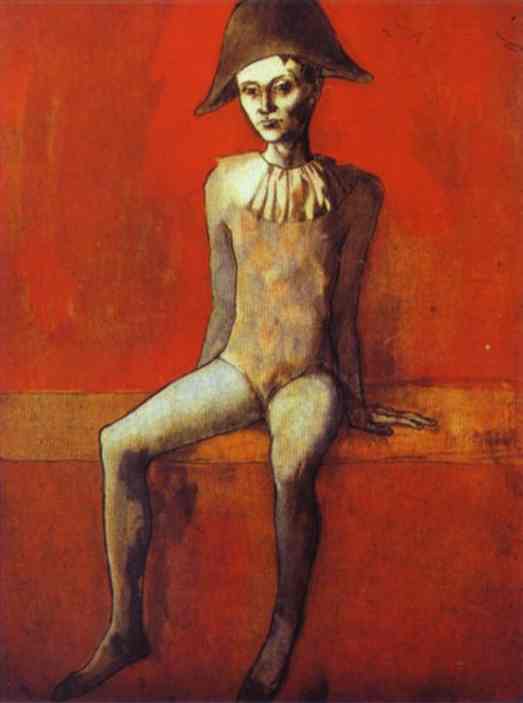
I have always had a soft spot in my heart for the wise fool or the sad clown. I love the fools in Shakespeare, and I love Picasso's circus performers. It seems pertinent that artists depict themselves as these characters, Picasso explicitly representing himself and his friends as traveling players, and in more subtle or nuanced ways, Shakespeare depicts the actors of performance in his plays, which functions nicely as a symbol of himself and his work.

In All's Well, the fool is named Levatch, and he's a bit of a curious character, sometimes overshadowed by the boisterous Paroles. The Globe education website gives some lovely interviews from their recent production of All's Well, including two with Colin Hurley the actor playing Lavatch. Here is the link to the first, and the second interviews. Do enjoy. Also, here are some Picasso harlequins, circus performers and just sad clowns. I imagine we'll use some of these ideas in costuming Levatch, and possibly Paroles as well.


Tuesday, September 13, 2011

Mysteries in Scotland

This post was going to be a broad survey of some information about altered book art, some links to etsy shops, some artwork by revered artists and some resources for further reading but maybe I'll write that other post later, because my plans have been derailed by a mystery.


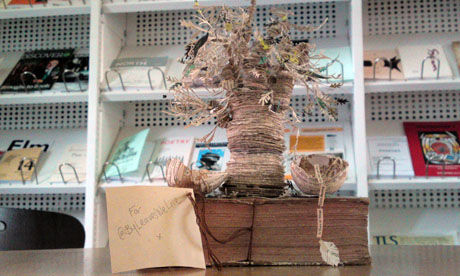
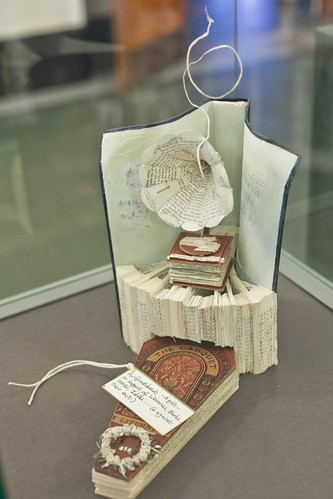
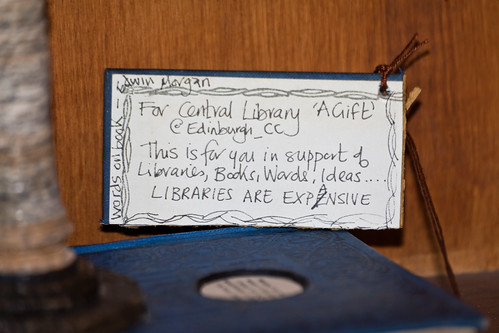
The Scottish Poetry Library has recently received an anonymous gift. A paper sculture of a tree, made all out of books. The Guardian is charmed but doesn't know what to think

Grand Central details the story as more sculptures appear, in an outpouring of love for books and for libraries.

These sculptures seem to be coming from one, exuberant lover of books and libraries. Although I love much of the progress towards digitized media, (this blog I'm writing is one I could not share without digitized text), I am sorry for the libraries. And what better way to celebrate the love of libraries than with artwork celebrating the paperness of books now.